Field Notes
Deinonychus
Say it: die-NON-ik-us
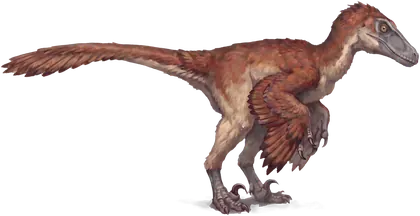
It means terrible claw. Early Cretaceous, about a hundred and fifteen million years ago, in what is now Montana and Wyoming. About eleven feet long, more than half of it tail, and about as heavy as a very big dog. Eleven feet is a small car. Standing up, the animal came to about a grown-up's hip. Bramble is a small one. Real animals come in sizes too.
Bramble's feathers are not made up
Deinonychus's close cousin Velociraptor has a neat row of little bumps down its forearm bone. They are called quill knobs, and they are the exact places a living bird grows its wing feathers from. A quill knob is about the size of a poppy seed, and on a turkey wing you can feel the row of them with a thumbnail. We have the bone. Anybody can count the bumps. Deinonychus had arms that were wings and never flew with them.
The famous claw was not a knife
Scientists built a mechanical leg with a real-shaped claw on the end of it and tried it on meat. It turned out to be bad at slicing and very good at hooking and hanging on. So a Deinonychus probably did what a hawk does — land on something, dig in, and stay there. Bramble pins things. He does not slash them.
How we know
A paleontologist called John Ostrom dug Deinonychus out of a Montana hillside in the last days of a field season in 1964, and spent five years working out what he had: an animal built like a bird, light and fast and warm. That one animal is the main reason scientists now agree that birds are dinosaurs. There is a dinosaur on your bird feeder.
What we made up. All the parts that matter. No dinosaur ever wore a hipseat and none of them ever picked out a kid. The size, the feathers, the feet, and the fact that he never roars are real.
This page is printed at the back of Signal Green, one of ten. Copy it, print it, read it out in a classroom — that is what it is for.