Field Notes
Maiasaura
Say it: my-ah-SAW-ra
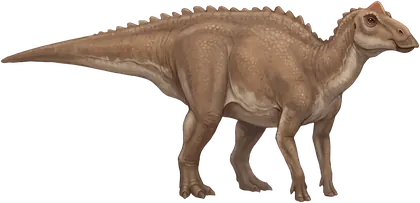
It means good mother lizard, and it is one of the only dinosaurs named for what it did instead of what it looked like. Late Cretaceous, about seventy-six million years ago, in what is now Montana. A grown one was around thirty feet long — about the length of a bus — walked on four legs, ran on two, and ate a very great deal of everything.
A woman who ran a rock shop found the babies
In 1978 Marion Brandvold picked up some very small bones on a Montana hillside and showed them to two fossil hunters, Jack Horner and Bob Makela, who came back and dug. What they found were nests with young dinosaurs still sitting in them — and the young ones were three or four times the size of a newly hatched animal, with their teeth already worn down from chewing. That is a baby that stayed home a long time and did a lot of eating while it was there. Somebody was bringing it food. Not everyone agrees about how helpless the babies were — some scientists who looked at the same leg bones think the hatchlings could get about better than that — but nobody argues about the big ones sitting in the nests, and that is the part this page is built on.
The nests were parked one adult apart
Mound after mound after mound, and the gap between them was about the length of one grown Maiasaura — roughly twenty-three feet, which is exactly enough room for a thirty-foot animal to walk between the nests without putting a foot in anybody's eggs. That is a colony, not a family. And they came back to the same ground the next year, and the year after that.
How we know
The place is called Egg Mountain. There were more than a dozen mounds on it and thousands of pieces of bone, and it is the reason people stopped picturing dinosaurs as animals that laid eggs and walked off.
What we made up. The Ox Bow, the Roost's arrangement to re-bank the mounds every spring for eggshell and dung, and Holly — including the thing she does at the end of a day, which is walk a line of children and stop at each one. No bone anywhere can tell you whether an animal did that, and we would very much like one that could. Real: the colony, the mounds, the spacing, the nestlings that were far too big to be newly hatched, the worn teeth, and Marion Brandvold, who found them.
This page is printed at the back of Nine Minutes, one of ten. Copy it, print it, read it out in a classroom — that is what it is for.