Field Notes
Microraptor
Say it: MY-kro-rap-tor
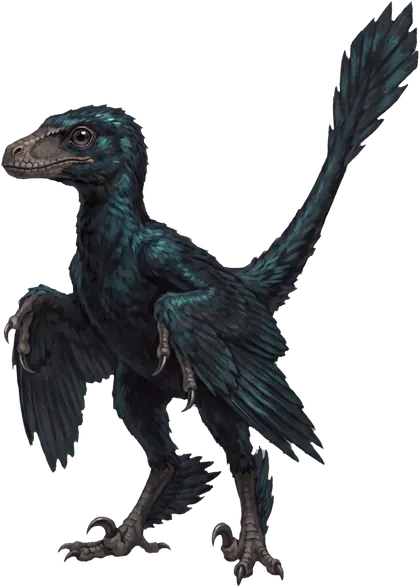
It means small thief. Early Cretaceous, about 120 million years ago, in what is now northeastern China. Three feet long with more than half of that tail, and about as heavy as a loaf of bread. Parrot is one of the big ones.
It had four wings, and two of them were its legs
Microraptor grew long stiff vaned feathers — proper flight feathers, with the shaft set off-centre the way a bird's is — down its arms and down its legs, all the way to the toes. The fossils have them, pressed into the rock like a leaf. Nobody is sure how it held the back pair. People have built models and put them in wind tunnels, and the models glide well and are not much good at flapping — though not everybody agrees, and some who have measured the shoulder think it could get itself off the ground under its own power. Either way, Parrot goes up something and comes down somewhere else, and that is not a shortcut we invented for him.
We have a good idea what colour it was, and it is not a guess about a mood
Inside a feather are millions of tiny pigment packets called melanosomes, and their shape and the way they stack decides the colour. Living birds that look glossy black with a green-blue shine — a starling, a grackle — have long narrow melanosomes packed in neat sheets. Microraptor's fossil feathers have them too, the same shape, stacked the same way. So this animal was black with an oil-slick sheen in it. That is not a measurement of the colour itself; it is a measurement of the packets, and then living birds tell us what packets like that do.
How we know
Microraptor came out of the ground in 2003, and its colour came out in 2012, off a slab that had been sitting in a drawer being black-and-white the whole time. New questions get asked of old fossils all the time. That is most of how this works.
What we made up. The talking. No fossil can tell you what an animal said, and nothing that ever lived has given a word back in somebody else's voice because a book needed it to. The four wings, the sheen, the fish in the diet and the gliding are all real.
This page is printed at the back of Say It Again, one of ten. Copy it, print it, read it out in a classroom — that is what it is for.