Make It · Book Ten
Passed Minute
Two hundred yards of hillside, twelve children lying in a line with one hand flat on the ground each, and a minute handed up the slope and handed back. When it comes home late, that is not somebody being careless. That is the ground telling them something, and it is the last thing anybody learns before the hum comes back. Nell built it out of nothing at all, and so can you.
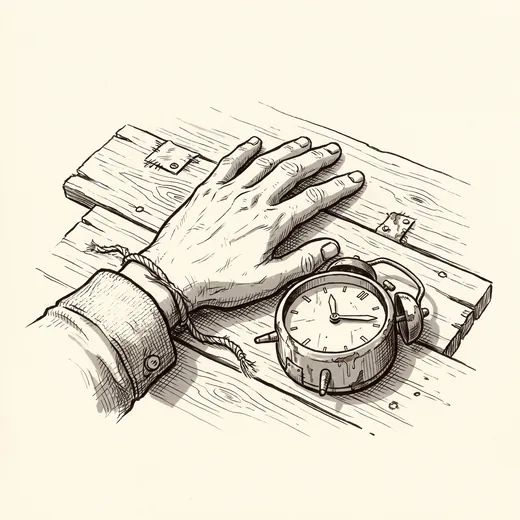
You need
- at least four people
- one clock that counts real seconds
- a pencil and some paper. No string
- no rope and no cord goes anywhere near this one.
About half an hour. Everything on that list came out of a kitchen, which is the rule these pages are written to.
Steps
- Stand your line out. One person every few paces, far enough apart that you have to speak up and near enough that you never have to shout. Everybody faces the same way, so nobody at your end can see what the far end is doing.
- The person at one end is the Keeper. The Keeper holds the clock and writes down the time it starts.
- Everybody else puts one hand flat on the ground and leaves it there. That is the whole of the job.
- The Keeper says gone, and counts sixty in their own head, at their own speed, without saying the numbers out loud. On sixty they say gone again, and the next person along starts their own sixty.
- It goes up the line that way, one minute at a time. The last person turns it round and sends it back down the same road.
- When it reaches the Keeper again, the Keeper counts one last sixty and writes down the time.
- Now do the sum. Count the people, double it, and that is how many minutes the line said it took. Look at the clock and see how many minutes it actually took. Write both numbers down. Do not argue with the clock.
Why it works
Nobody counts a minute at the minute's speed. Some people run fast and some run slow, and over a line of ten it stops being a wobble and starts being a number. That is why the Roost sends a count out and gets it back instead of trusting it once, and it is why Nell wants the same figure three times before she will build anything on it.
Try this
run it again with the line in a different order. The answer changes, and it changes the same way every time — because one person in your line is your fast one and one is your slow one, and after three runs you will know which. Then swap ends and see whether the Keeper was any better. Careful — read this bit before you stand anybody anywhere. This is a standing-still-and-counting game and it stays one. Nothing is tied to anybody, and nothing goes round a neck, a wrist or an ankle — not yours, not a friend's, not a pet's. Set your line out somewhere you are allowed to be, in daylight, and tell a grown-up where it is: never along a road, never on stairs, and never near a river, a pond or a pool. Keep everybody in sight of somebody. And if a person in the middle of the line has had enough of standing in the cold, they say so and the line gets shorter, which is also how it works at the Roost.
Nothing points at a person.