Make It · Book One
Table Net-Caster
Twenty minutes, and everything in it came out of a kitchen. In Chapter Eight the Roost throws a grapnel ninety feet and a rolled-up bridge goes out behind it, and the part nobody watches is the folding. How you fold a thing decides how it opens. That is the whole trick, and you can prove it on a table.
You need
- a mesh bag from onions or oranges
- four paper clips
- a cereal box
- tape
- scissors
About half an hour. Everything on that list came out of a kitchen, which is the rule these pages are written to.
Steps
- Cut a square of mesh about as wide as this book is tall.
- Clip a paper clip onto each corner and pinch it shut. Those are your weights.
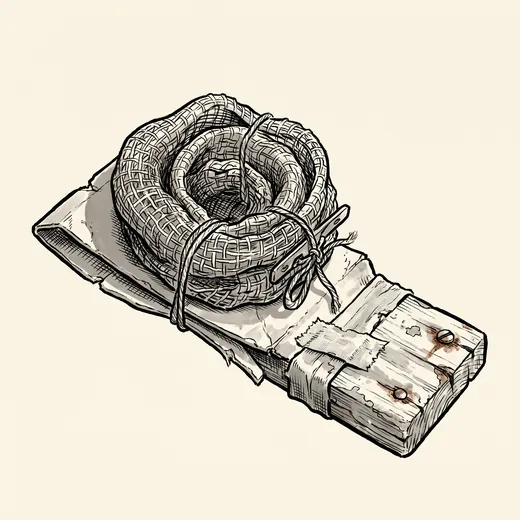
- Pinch the middle, lift it, let the corners hang, and fold the hanging part into a loose spiral — like winding a hose, not like crumpling paper. How you fold it is the whole trick.
- Cut a strip of cereal box two fingers wide and as long as your forearm. Fold it into a V a third of the way along. That is your thrower.
- Tape the short arm flat to a table edge so the long arm sticks out over the floor and springs when you push it down.
- Set the folded net on the end of the long arm, push down, let go.
- If it opens too soon, fold it tighter. If it never opens, clip a fifth paper clip across two corners.
Try this
Put a paper cup on the floor and find how far back you can stand and still cover it. Write your best distance on the thrower in pencil. That is a range card, and Nell paints one on every rig in the Low Shop.
Why it works
A folded net has to come apart in the air, and it only does that if the corners are heavier than the middle and the folds let go in order. It is the same reason the Roost rolls its bridge up instead of stacking it in a heap. A roll opens from one end. A heap opens nowhere.
Point it at the floor
Not at a window, not at a pet, not at your brother.
Nothing points at a person.