Free to read, nothing to sign
The first chapter,
all of it.
The cold open and Chapter One of Signal Green, 1,762 words, exactly as they are printed. No email, no account, no sample that stops at the good bit.
Signal Green · Cold Open
Vee Toomey was four, and she had the rule by heart, which was the only reason she was allowed in the boat.
"Count the logs before you cross," Vee said, "and if a log has two knots on top, it is not a log."
"Again."
"Count the logs before you cross, and if a log has two knots on top it is not a log, and there should be more fish than this."
"That last part isn't in it."
"It should be," Vee said.
Pia let it go, because the child was not wrong. Day 1,096, and thirty lines in they had four catfish, a bullhead the size of a thumb, and somebody's shoe.
They worked the street from the north end, where two feet of brown water stood over the sidewalk and the parking meters came up through it like reeds. Forty-one set lines, tied off to parking meters, railings, a fire hydrant and one drowned mailbox. They ran them every morning before breakfast and rebaited whether they had caught anything or not. The boy did the knots. Dot bailed with a paint can and nobody had to tell her. Vee was allowed to hold the fish. That was the whole of Vee's job and she took it seriously.
The punt leaked out of one seam, politely. Behind them the Grove stood up out of the flooded blocks with its lamps still burning at a hundred and ninety feet. Nobody had gone up yet to put them out. Yesterday somebody had propped a door open up there and left it open all day. This morning it was shut again. That happened once a year, and Pia had stopped asking about it when she was seven.
"Line nine's gone," the boy said.
"Gone how?"
"Gone with the meter."
"Write it on your hand."
Going home meant crossing the mouth of the street, where the current came round the bank building and ran. Pia stood the pole up and looked, and counted, because that was what you did and it took no time at all.
Four logs. Five.
The sixth had two knots on top of it, an inch apart, and they were pointed at the boat. There was moss grown over the back of it, with a little duckweed in the moss.
Pia did not tell anybody to be quiet. Telling them would be noise. She put the pole down through the water instead of dropping it in, and pushed, and brought it back through the water instead of over it. They went across at the speed of a thing that is not going anywhere in particular. Vee explained to the bullhead why it was going to be eaten. The knots went by nine feet off the bow and did not turn.
At the landing she tied off and counted heads on the boards. Twelve.
Then she counted them again and got twelve.
Chapter One — The Yes List
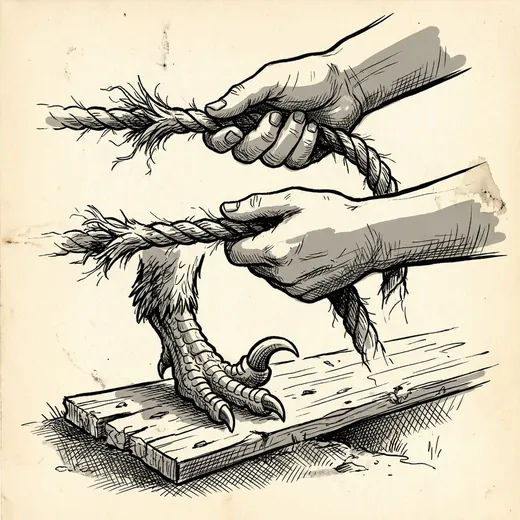
The rope was wrong in his hands before he was properly awake, and by the time he knew why, he was already thirty feet down the Ratline.
It was shaking, because a rope swings when somebody else is on it. This one jumped, went still, and jumped again, and it was coming up out of the ground.
Bramble came down beside him, two treads to his one, ticking on plank the whole way. Nobody looked up. Nobody ever looked up when Bramble arrived, because everybody had already heard him.
The Apron was half an acre of swept dirt, the only ground in the village that did not flood. At the south end the Gate hung between two posts, counterweighted with a bathtub of gravel, and one kid could shut it in six seconds. There had not been a grown-up in the world for three years, and nothing here was built for one.
The left post was new, and that was the trouble.
Knuckle had been driving it since before grey light — fifteen feet from beak to tail-tip, nine hundred pounds of him, ten inches of solid bone across the top of the skull. He backed off seven steps, put his head down, and hit the post. The post did not move, because it was in as far as the ground would take it, but a crack ran up the near face, top to bottom.
Jesper was at the rail with both hands on top of his head.
"How long?" Lars said.
"Since before I got here."
"What have you tried?"
"Feed bucket. He walked round it." Jesper held up a second finger. "Rope on the harness ring. He took me off my feet." A third. "Then I shouted at him."
"And?"
"It made him faster."
Nell came out of the shop wiping her hands, and looked at the crack for a while.
"That post has one more in it," she said. "Maybe two."
Six bells was sundown and the Gate shut at sundown. If it would not latch it stood open all night, with thirty-nine kids asleep above it.
"Can I ask him?"
"Yes," said Jesper, before the question was out.
So Lars did the thing he was better at than anybody in the valley, which was nothing.
He walked to forty yards and stopped, and let his hands hang open and low where they could be seen. He put his weight even on both feet and kept his eyes off Knuckle's face, and Bramble sat down on the shop step.
"Lars," he said. "Lars. Lars."
He said it the way you say a word you are trying to wear out. The animal hit the post and backed off, and he kept saying it. He said his name until it was not a word any more.
Then he moved to twenty yards and said what he wanted.
"I want you off the post. It's in as far as it goes and it's splitting, and if you keep at it we'll be cutting a new one in the rain tomorrow. That's what it's for. That's all of it."
Knuckle came round on his flank and struck sideways at nothing, and the air moved. Ten inches of bone went through the space where a boy would have been if the boy had stepped back. Lars did not step back, and two minutes later the animal did it again, at the same nothing.
At the rail somebody's spoon stopped tapping.
"He isn't doing anything," Nell said.
"That's the thing he's doing," said Odji.
Knuckle backed off for the next run and got to seven steps, and he stood there with his tail up and his ribs going, and he did not take it. Then he came over at a walk, sat down in the dirt like a dog with bad hips, put the whole dome flat against Lars's chest, and leaned.
Lars took the weight and did not move his feet. It was a great deal of weight, and the animal's breathing came down through it and his own went down with it. He stood in the sun holding up somebody else's dinosaur and was as happy as he had been all year.
The Apron clapped, and Lars stayed where he was so it would go on a moment longer.
Odji had a book open before the clapping finished. He wrote the day, the animal, whose animal it was, and left the end of the line blank for what the animal did in the three days after.
"Thirty-one minutes," he said. "That is the season's lend off this one."
"He's fine. Look at him."
"He will be off his feed by tomorrow and he will watch you for a week." Odji ruled a line under the entry and did not look up. "Twice off the same animal in a season and it stops answering you. Not for a while. At all."
"I'll only ever need him the once."
Odji wrote that down too.
· · ·
Between the Gate and breakfast, four people asked him for something.
A rigger wanted a long splice put back in a kite line, and never asked twice, so Lars answered the first time. "I'll get that."
A ten-year-old had seven jars of foxfire gone the color of a dirty window and one pair of hands, and read the dark ones off like a casualty list. "I'll get that."
Somebody's rooster was up on a span and would let nobody but a stranger take him down, and it made no sense and it was true. "Yeah. I'll get that." A kid with a crate of hose fittings wanted it shifted before school, and explained why at length, and was right. "I'll get that."
Somebody had chalked them onto the shop door before he got back past it. The column ran from the handle to the hinge and round onto the frame, longer than it had been all year. There was more on it than there was daylight, but Lars read the whole of it and rubbed nothing out, and it was a good score.
Gil was waiting at the foot of the Screw, off to one side, where nobody going up would have to walk round him.
"Not here," Gil said. "Walk with me."
They went along the rail toward the paddocks, and Gil had his boots off in one hand and his rope over the other shoulder, coiled the way rope is supposed to be coiled and never is.
"Today," Gil said. "Noon. At the mud-shelf gate, in the daylight. I need somebody standing there."
"Yes."
"You haven't heard what for."
"Noon," Lars said. "I'll be there."
Gil sat down on the bottom tread of the Screw, put his boots beside him, and started saying something under his breath. Four sentences of it, said a great many times before, in the dark, and the first three came out level. He got the last one wrong, and stopped, and started it again, and got it wrong in the same place.
Bramble lifted the left boot off the tread, carried it three steps and set it down, then came back and dropped a bottle cap into the right one, and stood there looking at Gil.
"He does that," Lars said. "He'll bring it back. How many people did you ask?"
"One."
"One's enough for what?"
Gil turned the boot over and the bottle cap came out into his palm, and he closed his hand around it.
"Standing at a shoulder while I say four sentences to five tons of Stegosaurus," he said. "Thistle un-chose me nine days ago. I've been getting up early so nobody'd see."
That is where chapter two begins, and this is where the free part stops.
Get Signal Green — $8.99Also free, and also the whole thing
Field Notes
The two nonfiction pages at the back of every volume: one real animal, two things we actually know about it, and how anybody knows. All ten are here.
Make It
One build a volume out of household junk, in numbered steps, under thirty minutes, ending in a number the child writes down.
The Roost
Where they live, what a day is, the bell code, how to say the names, and what every word in the books means.