Field Notes
Triceratops
Say it: try-SERRA-tops
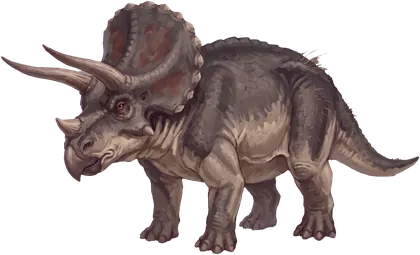
It means three-horned face. Late Cretaceous, about sixty-seven million years ago, in what is now Montana, Wyoming and the Dakotas. Nearly thirty feet long, and heavier than the biggest elephant alive today. Aunt Bess is a big one.
Triceratops had hundreds of teeth, and used them like scissors instead of like a grinder
The teeth sat in tight stacked columns, with a new one always growing up underneath to replace the one wearing out. Each single tooth was built from five different tissues that wore away at different speeds, so the tooth kept grinding itself back to a sharp edge while it worked. Triceratops did not chew round and round like a cow. It sheared, straight up and down, through fern and palm and anything else it could get its beak around.
A young Triceratops's horns pointed the wrong way
In a baby the brow horns curved backward over the frill. As the animal grew they straightened, then swung forward into the shape everybody draws. The bumps around the frill's edge did the opposite: they stood up in a ring of little triangles on a youngster and lay flat against the bone on an old one. You can tell roughly how old a Triceratops was by which way its face is pointing.
How we know
More than fifty Triceratops skulls have come out of one set of rock beds in Montana, which is a great many of one animal in one place. Scientists laid them out from smallest to largest and watched the horns turn around across the row. And somebody cut a tooth in half and put it under a microscope, which is where the five layers were counted.
What we made up. No Triceratops ever wore a harness, walked a treadwheel, or stopped for a dinner bell. The size, the frill, the beak and the teeth are all real — Triceratops really did have a solid frill, with no windows in the bone, which is why Aunt Bess can push with hers. The coarse bristles we give her over the hips are a guess: bristles like that are known from a much smaller cousin called Psittacosaurus, and nobody has ever found them on a Triceratops.
This page is printed at the back of The Salt Run, one of ten. Copy it, print it, read it out in a classroom — that is what it is for.